
There’s a version of this business where you just show up, set up, shoot, and leave. Get the footage, deliver the files, move on to the next job. A lot of production companies work that way. They can be anywhere and it doesn’t really matter.
As a Fort Lauderdale video production company that’s been based here since 2003, that’s never been how we work. And it’s never been more obvious than when someone asks us to help tell a story that this city already knows by heart.
We shoot nationally — healthcare systems, technology companies, corporate clients across the country but Fort Lauderdale is home. It’s also one of the most competitive markets in South Florida for video production, which means the companies that survive here for two decades do so by earning it. We know this city’s neighborhoods, its waterfront, its institutions, its history.
Occasionally a project comes along that captures everything we love about being a Fort Lauderdale video production company. These are two of those projects.
The Drum Family and the City They Help Build
When the Fort Lauderdale Historical Society honored the Cox-Drum-Clark family, they were recognizing something that goes back nearly a century. Ted Drum was born at Broward General Hospital in 1938. His parents moved here in 1935. His father-in-law Bob Cox ran a Gulf Oil marine gas station on the water starting in 1948 — and had the vision, as Ted puts it, that “a small Gulf oil marine gas station could become the gateway to the yachting capital of the world.” That station became Lauderdale Marina. Bob and Ted bought it in 1976, and it’s been an anchor of Fort Lauderdale’s marine industry ever since. 15th Street Fisheries, one of the most recognized waterfront restaurants in South Florida, came with it.
We were asked to produce a video profile of Ted Drum for the Historical Society recognition. The shoot itself was straightforward — interviews with Ted, his children, his grandchildren, and community members who knew the family’s contribution to the city. RED Cinema and Sony cameras, a gimbal for B-roll, careful coordination around Ted’s schedule and the event timeline.
But the real work happened in the edit suite. Ted’s story isn’t a business story — it’s a life story. Married to Carol for 50 years. Army service in combat. Six grandchildren. A family that built a business on transparency and treated every employee and customer with equal respect. The music had to hold all of that without overpowering it. The pacing had to let Ted speak — and let the people who love him speak about him — without rushing toward a conclusion.
If you want a measure of how deeply Ted Drum is woven into Fort Lauderdale history — he was an extra in “Where the Boys Are,” the 1960 film that put this city on the map for a generation of Americans. As Ted tells it, someone once said they spotted him in the movie. His response: “Maybe.”
The finished video premiered at a Fort Lauderdale Historical Society event, shown on a large monitor to a crowd that knew exactly who Ted Drum was and what he meant to this city. That’s not a typical screening environment for a production company. That’s a room full of Fort Lauderdale history, watching Fort Lauderdale history.
Southport Raw Bar 50th Anniversary
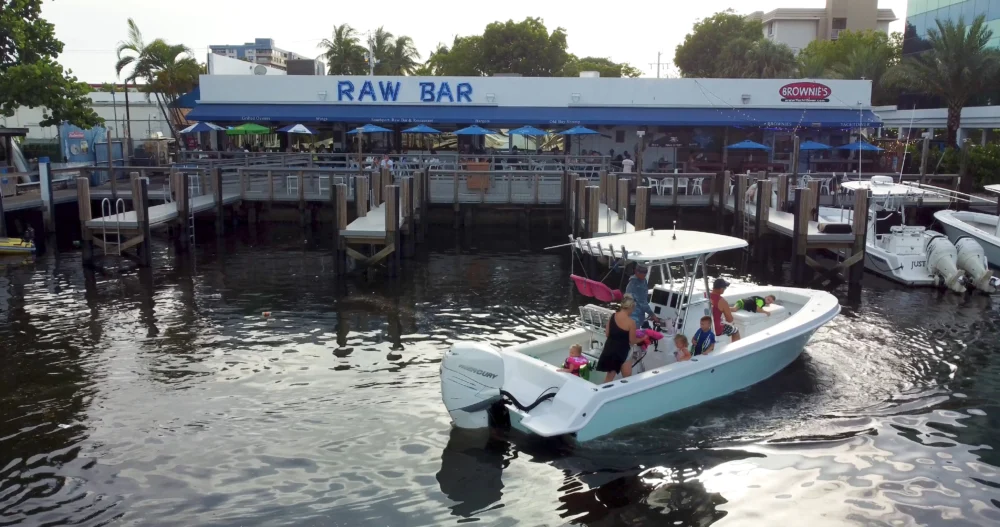
Southport Raw Bar has been on the water at 1536 Cordova Road since 1974. That’s fifty years of pitchers of beer and peel-and-eat shrimp, fifty years of cooks working in a kitchen “the size of a bathtub” putting out a thousand covers on a weekend night, fifty years of what Buddy Sherman — who started as a busboy in 1979, worked his way through every role in the place, and eventually bought it — calls “friends of Buddy.” FOBs. Everyone knows Buddy.
When Southport turned 50, they wanted a video that could hold the weight of that. Not a promotional spot. Not a highlight reel. A document of what the place actually is to the people who’ve been coming there for decades — the woman who quit nursing in 1979 because the restaurant was so fun, the man whose first date with his now-wife was at Southport 32 years ago, the customers whose kids once got crayons at the table and now come in with beards and order beers.
Again — the shoot was the straightforward part. Interviews, B-roll of the kitchen, the patio, the water, the staff. What made the video was the edit. Music set the tone for everything: warm but not sentimental, celebratory but rooted in something real. Buddy’s voice carries a lot of the film, but it was fellow restauranteur Tim Petrillo who summed it up when he said: “50 years in a restaurant is like 150 to 200 years in a regular business.”
The video premiered at Southport’s 50th anniversary party. Big budget, large crowd, multiple oversized monitors set up across the restaurant and the surrounding parking lots. They played it several times throughout the night. People who had been coming to that place for thirty years watched it and saw their own history reflected back at them.
That’s what the right video does. It doesn’t just document a milestone — it gives people a way to feel it.
Spreading Good News for the Last 30 Years
Since 1993, O&G PR has used the power of public relations to help organizations tell meaningful stories, build trust, and shape perception. So when they reached 30 years of successful client engagements, they invited us to help capture something deeper than a milestone—they wanted to tell the story behind their longevity. Not just what they’ve achieved, but how they’ve achieved it: the relationships they’ve built, the trust they’ve earned, and the consistency that’s carried them through decades.
We were genuinely delighted to collaborate with their team on this. From the start, it was a true collaborative effort working together to shape a narrative that felt authentic to who they are. Because at 30 years, it’s not just about experience—it’s about the people, the partnerships, and the reputation built over time. And helping bring that story to life, side by side with their team, was something we were proud to be part of.