
Results
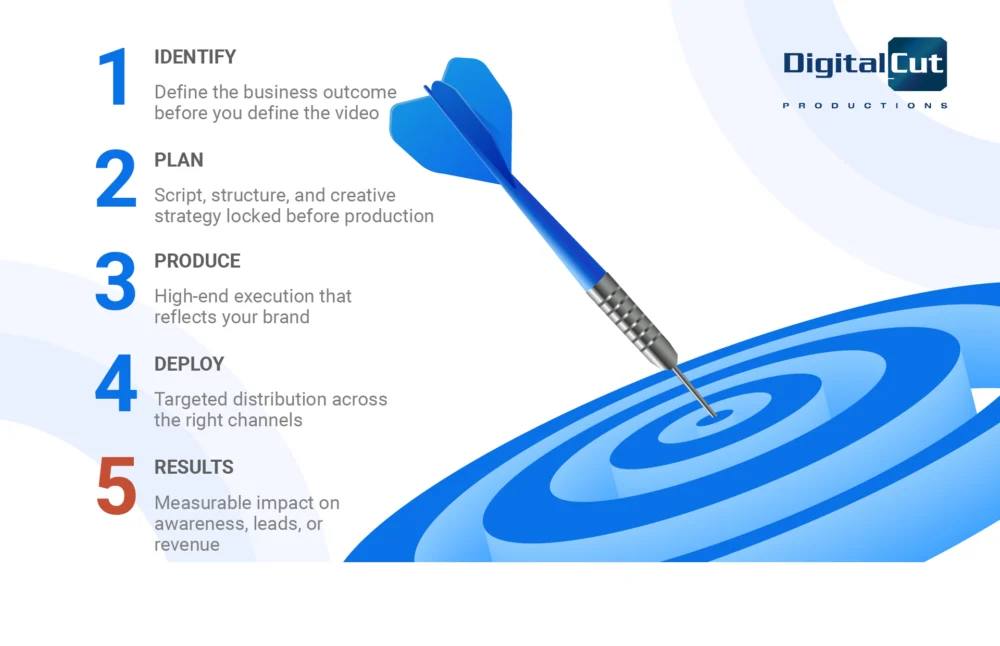
Video that drives revenue, raises millions, or accelerates a deal doesn’t start with a great concept. It starts with the right questions. And those questions get asked before the cameras ever roll.
These are the questions worth asking — and more importantly, how to actually answer them.
What specific behavior are you trying to change?
Not “increase awareness.” Not “tell our story.” A behavior. Are you trying to get a prospect who visited your website to request a demo? Get a donor who has given once to give again? Get a patient two hours away to choose a hospital they’ve never visited? The more precisely you can name the behavior, the more precisely the video can be designed to drive it.
How to get there: Write one sentence that completes this thought — “After watching this video, the right person will ___.” If you can’t complete that sentence, you’re not ready to shoot.
Who exactly is watching — and where are they in the decision process?
A video designed for someone who has never heard of your company does completely different work than one designed for someone who is three days from signing a contract. Awareness content is measured differently than conversion content. Deploying the wrong video at the wrong stage of the buyer journey is one of the most common reasons video underperforms.
How to get there: Map the three to five moments in your buyer’s journey where a prospect stalls, questions, or disengages. Those are the gaps video can fill. Build your production plan around closing those gaps, not around producing something that looks good in a board presentation.
What does success look like in 90 days — and how will you measure it?
View counts are not a business result. They are a proxy metric that tells you something about reach, not about impact. Before production begins, define what a meaningful outcome looks like for this specific video in this specific deployment context.
How to get there: Match the metric to the placement. A video on a service page is measured by time on page, scroll depth, and contact form submissions. Not views. A sales follow-up video is measured by response rate and deal velocity. A fundraising video is measured by donation conversion rate. A social cut is measured by engagement and profile visits. Define the metric before the shoot. Then measure it.
Where will this video actually live — and for how long?
A surprising number of companies produce video without a deployment plan. The video gets added to the website, shared once, and forgotten. A well-produced video has a useful life of three to five years and can work across a dozen channels simultaneously if someone has thought through the deployment before production begins.
How to get there: Before finalizing the production scope, list every channel where this content could live — website, sales outreach, email nurture, proposals, trade shows, internal training, investor communications, social. Then build the shot list and delivery format around that list, not the other way around. One shoot can generate assets for all of it. But only if you plan for it in advance. (We covered the production side of this thinking in an earlier post — how two shoot days generated three months of content for one client.)
What happens after someone watches it?
This is the question most production briefs never ask. Video is not a destination. It is a bridge. Every video should have a clearly defined next step — a contact form, a scheduling link, a related resource, a direct conversation. Without a defined next step, even a video that performs well loses most of its value at the moment it ends.
How to get there: Before production, define the call to action and confirm it exists. If the video lives on a page with no form, no phone number, and no next step, fix the page before you shoot the video.
The difference between video that gets made and video that gets results
These questions are not complicated. But they are rarely asked before a production budget gets approved. The companies that ask them first — and answer them specifically — are the ones that can point to a video two years later and tell you exactly what it contributed to pipeline, revenue, or mission impact.
That kind of accountability is not accidental. It is the result of treating video as a strategic investment from the first conversation, not an afterthought once the edit is delivered.
If you want to see what that looks like in practice, the results speak for themselves.